

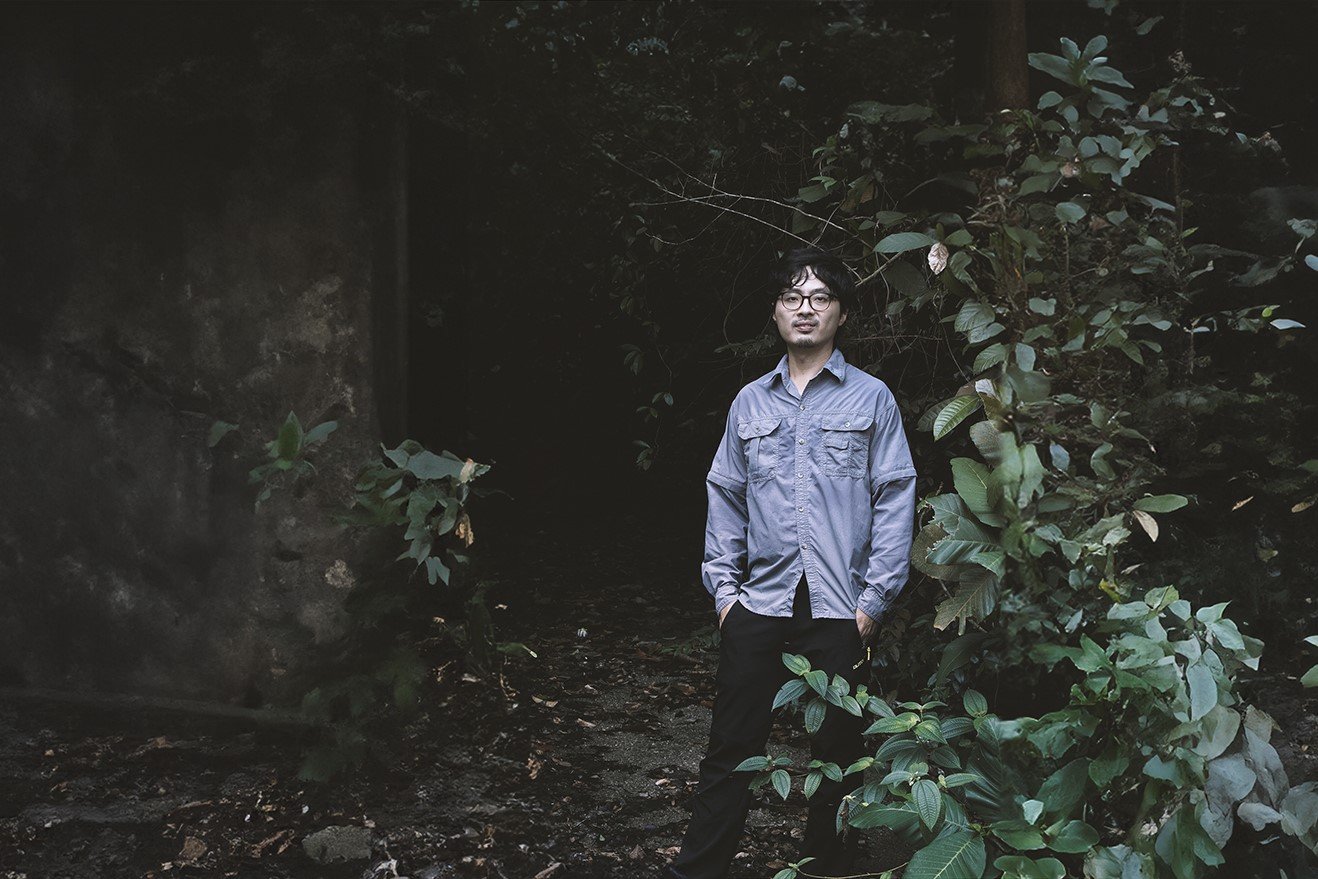
Robert Zhao Renhui: “Nature is not what we can dominate, but what comes through when we cannot control it.”
Singapore’s representative at the 60th Venice Biennale
Robert Zhao Renhui is a Singaporean artist who explores the complex and co-mingled relationships between nature and culture. While he first received critical attention for his photography works, Robert’s practice now encompasses installation, video and sculpture. One approach often employed by the artist is to utilise convincing narratives to invoke doubt in the audience. As such, he plays with concepts of truth and how it is portrayed.
Currently, Robert is representing Singapore in their national pavilion at the 60th Venice Biennale. Titled ‘Seeing Forest’ (2024), the presentation is a collaboration with Haeju Kim, Senior Curator at Singapore Art Museum (SAM). It is a culmination of Robert’s nearly decade-long research into secondary forests in Singapore, compiled from hundreds of hours of film footage. An earlier work exploring the same themes was exhibited at S.E.A. Focus 2022, with his photographic triptych ‘An Eagle Returns, Day 322′ (2020) depicting a changeable hawk-eagle drinking water from an abandoned container in a former military compound that has now been reclaimed by nature.
In this interview, Robert speaks about his experience in Venice as well as recent projects that ‘Seeing Forest’ builds upon.

As you look back on your artistic journey, was there any project/exhibition that became a turning point in your practice?
With every new work, I challenge myself to try something different, so I would not say that there is a specific turning point in my practice. But I have been making more video works in recent years. Something that required me to shift gears mentally was when I started doing multi-channel works, beginning with ‘Evidence of Things Not Seen’ (2021). Narratively, the use of multiple screens allows for more resonances, juxtapositions and “visual” open-ended storytelling. It has also allowed for a more ambitious scale for my installations.


Last year, you were commissioned by Esplanade – Theatres on the Bay to produce ‘Albizia’ (2023), an immersive performance installation that recreates one of the secondary forests in Singapore. Are there learning points from this production which informed your presentation in Venice?
Although both ‘Albizia’ and ‘Seeing Forest’ draw on my research on secondary forests in Singapore, they are very different projects. ‘Albizia’ was an immersive theatre production with timed entries and exits, and my aim was to create a dramatic and highly theatrical space where the set design played a major part. Hence, there was heavy use of landscaping to create the environs of a tropical forest, and I also recreated an illegal immigrant’s tent in the forest and a drain with running water.
That was a maximalist production. For the Venice exhibition, I went for a more minimal approach, preferring to let the videos do most of the heavy lifting. I re-cut the videos so that they engaged the attention and curiosity of people who wandered into the exhibition, even if it would just be for a few minutes at a time.


What was one unexpected challenge/obstacle that you faced over the course of developing ‘Seeing Forest’?
The main obstacle I had was throughout my days in Venice working on ‘Seeing Forest’. A small secondary woodland very close to my flat was being cleared, and I was not there to document the process as a way of saying goodbye and memorialising it. An exhibition can happen again, but not 20-year-old trees coming down. These were trees that I had brought my son to see almost every day since he was born.
After opening ‘Seeing Forest’ in April and having some time to absorb its reception, how do you feel about this entire experience?
To be honest, when I was not busy with setting up the show in Venice, I was preoccupied with thinking about how the show would have to be tweaked for the Singapore showcase in SAM next year. After returning to Singapore, I have been focusing on adapting the show for a local presentation, creating new installations and adding more artefacts and so on.
The experience has been enriching for sure, deepening and crystallising. Because of the high-profile platform, I wanted to present the most succinct, impactful and powerful experience to the viewer, and to convey my message about secondary forests being mysterious and wild frontier spaces which we may never fully know, but can all learn from.


Within the context of an international platform such as the Venice Biennale, does being an artist from Singapore/Southeast Asia bear significance for you or your practice?
Because of my interest in the intersections between humans and nature, Singapore presents itself as a unique story in this ongoing ecological debate about how we can coexist with nature. I met an Italian journalist in Singapore conducting a long-term study of Singapore’s concept of an eco-city. We had a long chat and it seems that our model is something that has become quite well-known. The story that I want to tell is one that is often neglected. Nature is not what we can dominate, but what comes through when we cannot control it.
Were there artworks or artists at the biennale you felt connected with, or made a strong impression on you?
I did not manage to see much of the main exhibition because I simply had no time. I am planning to catch it, plus most of the major pavilions in the Giardini, only when I return to Venice to de-install my work a few months later. I did visit some of the off-site and collateral shows, and one I enjoyed was Carlos Casas’s ‘Bestiari’ (2024). In his video installation, there are moments that the viewer becomes the animal, and navigates the world through their eyes.


Currently, you also have two decades worth of documentation and art books on view in ‘Evidence of Things Not Seen’ (2024) at ShanghART Singapore. Could you talk about the title as well as how you decided on the materials to present?
This exhibition was meant to provide a quick look at various bodies of work that have been shown overseas but not locally since 2008, which was when ShanghART started representing me. The title is from an older work of mine, and I liked how the phrase simultaneously conjures the feeling of something that can or cannot be apprehended directly. I guess this show is a “historical” show in that it collects archival material from old shows, which can only live through such images and documents.

Could you point readers to displays/archival materials which are particularly significant or sentimental to you?
The first image in the show, which showed me digging into the reclaimed land at Tanah Merah in 2011. It was the first time I seriously started investigating the history of land in Singapore.
Are there unrealised projects or topics you wish to pursue in the near future?
In Singapore, there are many so-called “introduced” and “invasive” plants and animals that are not “native”. I hope to visit where these species came from and understand what factors determine where non-human species belong.