

Yee I-Lann: “Maybe a socially-engaged art practice entails not turning away, making space for others and ‘letting go’…”
Community and collaboration in the Sabahan artist’s work
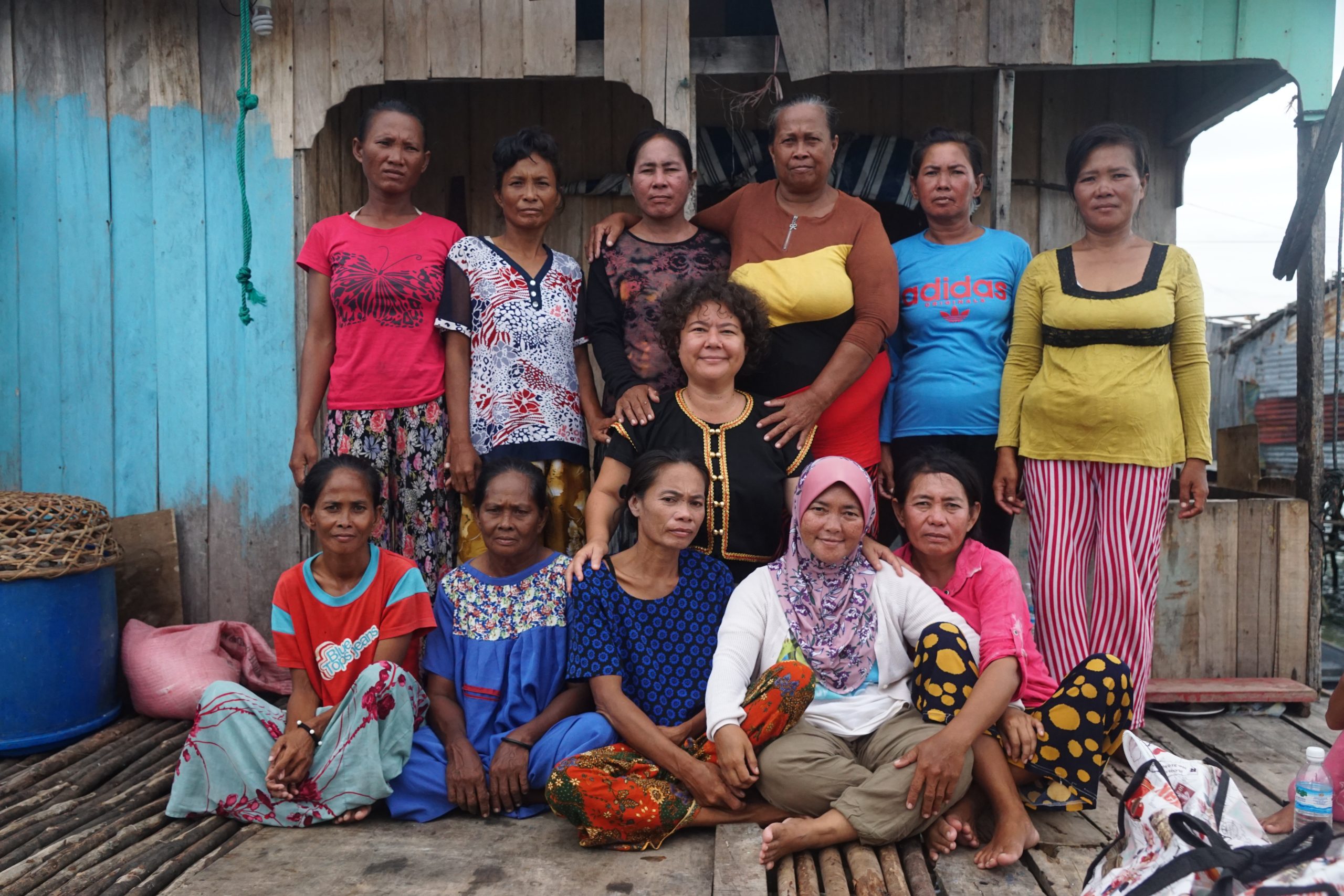
Since 2018, Sabahan artist Yee I-Lann, who is represented by Silverlens, has been collaborating with communities of weavers to make tikar, mats woven from bamboo or the Pandanus plant. They hail from two geographies: the inland community of Sabahan Busun and Murut weavers in the town of Keningau, and the sea community of Bajau Sama Dilaut weavers based on the islands of Semporna. This project speaks to a type of socially-engaged art practice where personal history, local knowledge, critical theory, and community engagement meet.

TIKAR/MEJA
Though it is commonly found in tourist markets across Southeast Asia today, the tikar is more than a craft product in I-Lann’s eyes. She sees the woven mat as a platform for communal gathering, where everyone sits together on the same level. The symbol of the mat is juxtaposed against that of the table, an invention introduced to Southeast Asia through the legacy of colonisation. For the artist, the table represents administrative power and hard patriarchal control. As a piece of architecture, the table creates hierarchies by elevating and excluding certain groups. This is opposite of the egalitarian, grassroot platform of the mat which is almost always woven by women.

This relationship between the mat and table comes together in the monumental ‘TIKAR/ MEJA’ series which has been exhibited internationally in Manila, Kota Kinabalu, Seoul, Basel, New York and other cities. ‘TIKAR/MEJA’ is the work which marks the start of I-Lann’s ongoing collaboration with the weavers. While their patterns and colours vary, a single standing table floats in the centre of each mat in the series. It suggests that the table can be rolled up, or “eaten” by the mat like in a game of rock, paper, scissors.
Sharing and making space
For I-Lann, conversations are at the heart of a socially-engaged art practice. “Maybe it entails not turning away, taking part in something, embracing responsibility and care,” she says. “It is about building relationships and communities, sharing, and making space for others for collaborative actions and ‘letting go’.” They are actions of inclusion towards collective benefit. Notably, the names of weavers who have worked on each piece are woven into the artwork, acknowledging their labour and essential roles as co-creators and storytellers. This system of mutual support is strengthened through initiatives that invest in the community, such as the building of the Balai Bikin, a community hall next to the weavers’ water village.


On her “other life” in the film industry
When asked about her experience as a production designer for feature films, I-Lann comments that both practices involve designing spaces for ideas and stories to unfold. She adds, “I feed off popular culture and what Milan Kundera called ‘political kitsch’ ,– how to activate and make short-cuts in knowledges and visual languages that a wide public already understands for your own propaganda!” I-Lann also describes film-making as a team sport that often happens under trying circumstances. The key is to create a conducive atmosphere for collaboration, in order to sustain energy and excitement towards the project.


‘Borneo Heart’ in Kota Kinabalu and Kuala Lumpur
The themes of community and collaboration are also extended into the presentation of this recent body of work. ‘Borneo Heart’ is an expansive travelling exhibition that started in I-Lann’s hometown of Kota Kinabalu in 2021. Hosted across several venues in Kuala Lumpur, its second iteration in 2023 coincided with Malaysia’s 60th year of nationhood. ‘Borneo Heart’ is an invitation to sit at the mat, or in the artist’s words “a space where things get activated”. Beverly Yong, Director of RogueArt and curator of ‘Borneo Heart’, highlights how “the exhibition itself has enveloped supporting institutions and independent teams and professionals” as the tikar works engage different practices and communities. The gesture of bringing together East and West Malaysia through this project carries strong personal significance to the artist who has deep roots in both geographies.

the sun will rise in the east
The period of organising ‘Borneo Heart’ was also one of introspection for I-Lann as she looked back on more than a decade’s work consolidated in her latest monograph the sun will rise in the east. Edited by Beverly Yong, who also worked on the artist’s previous monograph Fluid World, the publication is a collection of primary materials that informed I-Lann’s practice from 2011 to 2023. In many ways, this book is also a reflection of their journey through a friendship of more than 20 years, documenting the many ways in which they have worked together.
To learn more about the long-time collaboration, watch here for a recording of ‘Community and Collaboration’ at SEAspotlight 2024, a conversation between Yee I-Lann and Beverly Yong, Director, RogueArt, moderated by June Yap, Director, Curatorial, Programmes and Publications, Singapore Art Museum.
Dr Simon Soon: “’Contemporary’ is having one idea ricocheting through a field of possible connections, unsure of what forms it might land on.”
Insights on the evolution of Southeast Asian art from the modern era into the contemporary

Dr Simon Soon is a scholar and curator whose research focuses on 19th and 20th century art and visual culture in Southeast Asia. He has curated major exhibitions such as ‘Bayangnya Itu Timbul Tenggelam: Photographic Cultures in Malaysia’ (2021), and ‘Love Me in My Batik: Modern Batik Art from Malaysia and Beyond’ (2016) for ILHAM Gallery in Kuala Lumpur. Simon is also currently Lecturer in Art History and Curatorship at University of Melbourne.
In this interview, Simon offers his insights on the evolution of Southeast Asian art from the modern era into the contemporary. The topic is addressed from multiple perspectives, touching on Simon’s experience as an educator teaching art history as well as his involvement in publications that enrich the discourse.

You describe your research interest as “approaching art history from below”. What do you mean by that?
I suppose this idea of approaching art history from below is about an orientation and a vantage point. It stems from the fact that I do not come into the field of art history by happenstance entirely. Reading art history, developing artistic research, and sustaining curatorial practice are often seen as inter-related but clearly distinct fields in the study of art. However, I would like to propose how these seemingly disparate parts contribute to a sustained inquiry into the connected or intersecting cultural histories of specific forms and ideas.
Professor Patrick Flores in his essay, “Curatorial Circulations in Southeast Asia” for Yishu: Journal of Contemporary Chinese Art and Professor TK Sabapathy in his curatorial notes for the exhibition Intersecting Histories: Thoughts on the Contemporary and History in Southeast Asian (2012) at ADM Gallery, School of Art, Design, and Media at the Nanyang Technological University in Singapore, have discussed how exhibitionary and curatorial practices serve as effective methods for exploring new ways of understanding.
I am also fascinated by how different modes of “seeing” can generate “imagistic” power that may not be fully comprehensible through the theoretical frameworks commonly used by academic art historians. This suggests the need for alternative approaches to interpretation.


You recently joined the University of Melbourne, after teaching for eight years at the Faculty of Creative Arts, Universiti Malaya in Kuala Lumpur. How has your perspective/approach on the teaching of modern and contemporary Southeast Asian art changed over time?
For the past eight years, I taught two subjects in Southeast Asian art history: Modern Southeast Asian Art and a survey of Art and Architecture of Southeast Asia. I believe these subjects were inherited from the late artist, curator and art historian Redza Piyadasa, who founded the Visual Arts Programme at Universiti Malaya in 2003. Modern Southeast Asian Art explores the region’s modern art in relation to its social, political, and economic contexts from the 19th century to today, focusing on narratives of “worlding”. The survey course examines Southeast Asia’s diverse cultural histories over 2000 years, emphasising connections with global cultural influences. In both instances, the focus is to challenge the idea of Southeast Asia as a fixed region entity.
Joining a new university is an opportunity to take a step back from a regionalist approach centered on Southeast Asia as a geopolitically determined configuration. It allows me to see how my understanding of the region can contribute to the teaching of more connected or comparative art histories. I look forward to working with colleagues to deliver subjects that foreground a more Asia-Pacific focus as well as a study trip to Indonesia and Singapore.

You are a co-editor of Narratives in Malaysian Art Vol. 4, the final volume in the series which was published in 2019. In your observation, what are important shifts in the discourse on Malaysian art from the modern period into the contemporary?
My main role in Narratives in Malaysian Art Vol. 4 which has a focus on “Perspectives” was to prospect different ways in which art history of Malaysia has been written and direct readers’ attention to some of the issues that have been foregrounded by colleagues in the field. Towards this end, we have present-day researchers reflecting on seminal texts that have by and large shaped the tenor and tone for what we understand loosely as Malaysian Art.
We also featured new writings that problematises the category of what counts as Malaysian art (Ray Langenbach), discusses the challenges to our understanding of knowledge that new media raised (Roopesh Sitharan), spotlight colonial women artists as an occluded category of artistic agents within Malaysian art history (Yvonne Low), and also discusses how the “revolutionary” image is missing from how we write Malaysian art history (Au Sow Yee). Collectively, they raise questions that challenge the idea of the nation, imagining new connections, perspectives, and positions that could create a more inclusive and meaningful art history for future generations. In turn we see how the shift from modern, with progress idealised as a linear and singular narrative, into contemporary discourses that recognise that the narratives of Malaysian art are always already plural and sometimes even playful.

As a follow-up to the previous question, do these shifts play similar roles in the development of artistic styles in other regions in Southeast Asia?
I suppose it would be a reckoning with what the national or one’s locality means through form-making or form-expressing. As such, it is also about the kind of artistic genealogy one is constructing. To paraphrase the title of Paul Gauguin’s 1897 painting, this requires us to ask ourselves: where do I come from? What am I? Where am I going?
I like my long-term colleague Professor Roger Nelson’s idea of tentacular thinking, which draws on Mieke Bal’s concept of the unfaithful octopus where the adaptive agency of artists, curators and researchers are foregrounded. This concept posits that artists, curators and art historians are giving themselves the permission to connect with a wide array of timelines, materials, histories. The purpose is to spotlight their comparative value or bring them into collision to produce a different way of seeing how we understand ourselves, through often playful means.
I believe this is something that is happening not just across Southeast Asia but also more broadly across an increasingly connected world. In doing so, we might take on a much more fluid definition of locality and how it shapes our sense of self and belonging in this world. Therefore, it also informs how we think through images and communicate through forms that are not necessarily wedded to the discourse of the nation or any easily identifiable framework. This uncertainty may be a cause for consternation and anxiety for an earlier generation of scholars who came into art history through the certitude of modernism. Scholars, artists and curators working today are departing from many more diverse vantage points.

What does the term “contemporary” mean to you?
I believe the composite is a methodological principle that undergirds many of the things I do. This principle has a long history in the study of art. One could trace it back to German art historian Aby Warburg’s Atlas Mnemosyne, which is given a low-brow update in the form of a Gen-Z vision board. It is not like I do these vision boards particularly well, but it fulfils the type of angin (wind) that courses through me. In the East Coast of West Malaysia, the concept of angin as channels of desire that shape personalities speak to an idea of how we are driven and motivated by inner winds of desire. A vision board as an approach allows me to connect this concept to the Germanic concept of geist or spirit in some tenuous way although the worldviews that these concepts emerge from might be continents apart.
It helps me to think about possibilities of connection which is the hallmark of the contemporary. It does not have the certitude of a clear explanatory grid which is the attribute of modernism in all its idealised systemic and structural purity. It makes for a more amusing and fascinating world if we are willing to let ourselves go a little. I like to think of the contemporary in this way: one idea ricocheting through a field of possible connections, unsure of what forms it might land on. It is an imagistic form of thinking that has certain power and resonance.

From your observations, how have Southeast Asian artists adapted to the shifts between these two art historical periods?
There is no easy answer to the question. However, we can begin to understand the complexity of this shift through a report on the “Terminologies of ‘Modern’ and ‘Contemporary’ Art in Southeast Asia’s Vernacular Languages” (2018) published by the journal Southeast of Now: Directions in Contemporary and Modern Art in Asia, which I contributed to. In my section, I reflected on Ismail Zain’s 1980 lecture “Seni dan Imajan” (“Art and Imagery”), which outlines a way of seeing that characterises artistic forms in our time.
Ismail Zain contrasts two types of artistic vision: “syncretistic” and “analytic”. The “syncretistic” vision embraces everything at once, drawing from diverse cultural references across time and geography, blending art, craft, and popular culture. This store of cultural resources was viewed as the inheritance of the contemporary artist. In contrast, the “analytic” vision focuses on one specific point and maintains neat distinctions. Learning to see the world in “syncretic” terms also then leads to the recalibration of our understanding of art and culture. In doing so, Ismail Zain proposes that the re-imagination of creativity in the contemporary era challenges the power of modernity and colonialism in shaping the production and reception of art.

Deborah Iskandar: “Living with art you love is the most rewarding return on investment you can achieve.”
Founder of ISA Art and Design shares her journey in the art world
Deborah Iskandar is the Founder of ISA Art and Design with almost 30 years of art market experience under her belt. She officially entered the art world when she brought the international auction house Christie’s to Indonesia in 1996, and later joined Sotheby’s in 2009 as their Managing Director. In 2013, she started her independent advisory which assists private and corporate clients in sourcing artworks and building collections.
More recently, a physical space for ISA Art Gallery was established in 2020 with a focus on promoting the practices of women and Indonesian diaspora artists, as well as having an interest in new media art and the secondary market. S.E.A. Focus welcomed ISA Art Gallery’s participation for the first time in the 2024 edition with a presentation of works by A. Sebastianus Hartanto.
In addition to her role as a consultant and gallery owner, Deborah is a long-time collector. We had to ask how she plays these multiple roles and what are her observations on the Southeast Asian art market.

Your background is in finance law before entering the auction business in the 1990s. You have been an art consultant before establishing your own gallery in 2020. How have these worked out for you?
After leaving the auction house, I sought a moment to pause and reflect on the pace of the past 15 years. During this time, I had ventured into launching a startup that fused Indonesian luxury with art and design, driven by my passion for art and interior aesthetics, and my belief in living with art. Concurrently, I began art consulting to integrate art into architectural and interior projects. Often, I encountered clients with exquisite homes devoid of art due to time constraints or limited interest in acquiring works. Introducing this concept was slow-going in Indonesia initially; I started with just one or two projects annually, aligning with my desire for a more measured workload. Gradually, the momentum picked up.
Opening a gallery had not crossed my mind initially. While consulting, I discovered artists such as Sinta Tantra, Ida Lawrence, and Ines Katamso, whose works resonated deeply with me. Interestingly, my office was housed in my former residence, located in a flood-prone area of Jakarta. The upstairs space served as a workspace, while it remained vacant downstairs. Following a Feng Shui master advising me to “activate the downstairs”, the idea to open a gallery was sparked. Thus, on 3 March 2020, we inaugurated our new show, only to close two weeks later due to COVID-19. Despite the setback, the concept took root. We persisted through the pandemic, driven by a newfound passion to champion young Southeast Asian artists, particularly women—an under-represented niche in art collecting.

How would you describe your own collecting interests, and strategy, if any?
At heart, I am a collector. It began when I was 26, with my first painting purchase, and since then, my passion for collecting has only grown. My initial collection focused on non-conformist art from the former Soviet Union. I bought it during an art exhibition in Hong Kong. Later, I moved to Indonesia in 1991 and during my time at Christie’s from 1996 to 2007, my interests expanded to include Vietnamese and Indonesian modern art. For example, I was collecting works by Le Pho, Mai Trung Thu, and Vu Cao Dam, and eventually it evolved into a fascination with contemporary Asian art. I visited the studios of Agus Suwage, Yunizar, Masriadi, and Rudy Mantovani, among others, and I systematically started collecting works by the top contemporary artists like Arahmaiani, Heri Dono, Jompet Kuswidananto, and others.
Now, as a gallerist, I encounter numerous opportunities to acquire works by promising young Indonesian and Southeast Asian artists, continually enriching my collection.
Like many collectors will attest, it is more than a hobby; it is an addiction.

How do you usually advise your clients to collect, and how would the advice differ between a new collector, and for someone who has already built one?
When starting out as a collector, it is crucial to buy what you love and also what you can afford and, most importantly, to make informed decisions. Engage with gallerists, curators, and approach art with a discerning eye! I often advise new collectors to refrain from purchasing anything for the first six months because your taste will evolve as you immerse yourself in the art world and deepen your understanding.
For seasoned collectors, the pursuit never ends. Continuously explore and assess your collection to identify areas to enhance and fill gaps. As an auction house executive, I had the privilege of handling numerous exceptional private collections. The most successful sales came from collectors who meticulously curated their collections over a lifetime, creating narratives that spanned art history and told compelling stories.

In your opinion, what is an investment in art?
While I did not initially buy art as an investment, it has proven to be an exceptionally wise one. Art, as an asset, often requires holding onto for 20, 30, or even 40 years to see substantial returns. Beyond financial gains, art is meant to be cherished and experienced, not merely stored away. This belief led me to venture into consulting, placing art in public spaces such as hotels and private homes.
When acquiring art, conduct thorough research, but prioritise pieces that resonate personally. Living with art you love is the most rewarding return on investment.

Could you talk about your approach to designing a home/office/space for art?
Designing a home, office, or any space with art involves a creative and collaborative process that goes beyond mere decoration. It is fun! The selection of the art can determine the mood of the space, so it is an opportunity to imbue the space with personality and ambience, guided by the architectural and interior design context. Whether the person prefers minimalist, graffiti, contemporary, modernist, landscapes, or other styles, each choice reflects their personal taste and can communicate aspects about their identity and interests.
Working closely with clients, architects, and interior designers is essential in this journey. It is about understanding the client’s vision for the space and aligning it harmoniously with the chosen artworks. This collaboration ensures that the art enhances the overall aesthetic and functionality of the space, creating a cohesive and enriching environment that resonates with the individuals.

From your experience, what have you observed about collector sensibilities when it comes to modern and contemporary Southeast Asian art? In what ways are they similar and/or different?
One trend I have observed among collectors in Southeast Asia, especially in Indonesia, is their preference for Western art due to its perceived rapid appreciation in value. However, I personally find this to be the least compelling reason for acquiring art. Many Asian artists have received education in prominent art schools in London and New York, placing them on par with Western artists in terms of quality and influence.
Interestingly, there’s a noticeable shift towards Asian art as well. A growing number of young collectors are showing keen interest in contemporary Indonesian art. They connect deeply with artworks that reflect themes such as governmental issues, societal challenges, and the impact of technology. These are artworks that challenge the status quo.
Moreover, 21st century art encompasses more than traditional oil paintings on canvas — it includes new media art forms. This diversity adds an intriguing dimension to any art collection.

In your opinion, what is the relationship between a platform dedicated to Southeast Asian contemporary art, such as S.E.A. Focus, and its market?
I believe platforms like S.E.A. Focus plays a crucial role in the Southeast Asian contemporary art market. Our participation in S.E.A. Focus earlier this year was particularly enlightening, as it highlighted a growing enthusiasm among collectors from Taiwan, Japan, and Korea for Indonesian and Southeast Asian art. Such platforms not only stimulate interest but also facilitate focused collection building within the realm of Asian art.
Moreover, S.E.A. Focus serves as an essential educational platform, fostering greater awareness and appreciation for art across the region. By showcasing diverse artworks and facilitating dialogue among artists, collectors, and curators, it contributes significantly to the cultural exchange and enrichment of Southeast Asian art practices.
Taking a broader global perspective, could you also speak to the value proposition for Southeast Asian art, especially considering prices of primary market contemporary works by Euro-American artists.
From a global perspective, I believe investing in Southeast Asian art presents a broader opportunity, particularly due to its historically undervalued status compared to primary market contemporary works by Euro-American artists. The disparity in valuation can be attributed to the West’s extensive infrastructure supporting art, including museums, biennales, curatorial networks, and media coverage that spans centuries. In contrast, Southeast Asia, and Asia more broadly, lacks such structure, making it challenging for Asian artists to build credentials such as museum exhibitions or mentions in influential publications like the New York Times.
However, I see this landscape evolving positively with increasing global interest in Asian art as a distinct and valuable category. As awareness grows and investments in cultural infrastructure rise across Asia, we are likely to witness a gradual leveling of the playing field. This shift not only enhances the recognition and market value of Southeast Asian artists but also enriches the global art discourse by diversifying perspectives and narratives. Therefore, investing in Southeast Asian art now not only holds potential financial returns but also contributes to the enrichment of the global art community.
Deborah Iskandar was a speaker in the SEAspotlight Talk ‘To Market, To Market, To Buy an Artwork: Investing in Southeast Asia’, which took place in January 2024. Watch the recording of this panel discussion for more on the value of Southeast Asian art and the outlook on its market.

Leong Puiyee: “Being a part of Southeast Asia, it is only natural to highlight the stories from the region.”
Understanding short films as an artistic medium for storytelling
Leong Puiyee is senior manager at Objectifs – Centre for Film and Photography, a non-profit visual arts space in Singapore. With more than 15 years of experience in the field, she curated the ‘Women in Film’ and ‘Asian Film Focus’ annual programmes at Objectifs, and was also Programme Manager (Short Films) for the Singapore International Film Festival (2014-19). She has also been a member of the selection committee for the Busan International Film Festival (2023), Bangkok ASEAN Film Festival (2020-21), and SeaShorts Film Festival (2017-18), among others.

What is it about the medium of film/short films that sustains your interest?
Film is a reflection of life, our emotions, the people and world around us. Being immersed into a world for that 10 minutes or 2 hours allows us to feel sad or happy, to ponder about certain social issues, to understand a culture that we are unfamiliar with. To me, that is the beautiful thing about film, as sometimes you do not know what to expect when you are in that world for that time period.

The Objectifs Film Library is an educational and research resource focused on short films from Southeast Asia. Could you talk more about the approach to this collection and the public programming around it?
The Objectifs Film Library collection was started with a focus on short films from Southeast Asia, and to bring attention to the importance of the short film medium. Being a part of Southeast Asia, it is only natural to highlight the stories from the region.
As part of the Library’s focus on short films, a programme we organised around it is the Objectifs Film Club. The Film Club is a quarterly event that highlights a short from the Film Library, and it features discussions between the filmmaker and arts/film practitioners about their films.
We also did an exhibition titled ‘Objectifs Cinema: Now Showing’, to celebrate the richness and diversity of Southeast Asian short films from the Film Library. Selected short films were screened over the course of the exhibition based on a thematic approach. There were public talks with film professionals to complement the exhibition.
Through these programmes, it offers the opportunity for filmmakers and enthusiasts to gather and exchange ideas.

You have curated a number of film programmes such as ‘Women in Film’ and ‘Asian Film Focus’, and was also Programme Manager (Short Films) for the Singapore International Film Festival from 2014 to 2019. What is a trend you noticed in organising these events?
Because the world and people are constantly changing, the stories that people are telling tend to be a reflection of the times. Personal stories continue to be a constant in the film landscape, as it is a rumination of the filmmaker’s self and life.

Objectifs collaborated with S.E.A. Focus on the film screening programme ‘OFF Focus’ for this year’s edition, and will be doing so again in 2024. How do collaborations with art platforms such as S.E.A. Focus align with Objectif’s mission of fostering dialogue and advancing appreciation of visual storytelling?
Collaborating with a partner like S.E.A. Focus is an important part of what we do at Objectifs as it not only allows us to support artistic networks, but to also foster a dynamic and creative environment for both parties.
Building on the previous question, can you talk about the differences and/or the draw of artist-made films as compared to those made by filmmakers?
The wonderful thing about the film medium is that it can offer a breadth of perspectives and there can be many ways to present an idea or story. With the ‘OFF Focus’ programme, it allows us to present works that challenge our understanding of storytelling, and to broaden one’s outlook on films.

What are your hopes for the future of short films in Singapore and the region?
I hope that the short film medium can be seen as an art form in its own right, breaking away from the notion that short films are a “stepping stone” to a filmmaker’s feature film career. Short films are more than that. It allows for experimentation, play and you can take more risks with short films compared to a feature film. And of course, I would wish for more people to embrace and appreciate the beauty of short stories.
This interview has been edited.

Patrick Flores: “The diplomatic impulse is a relational impulse and underlies much of artistic and curatorial work.”
On ‘Chances of Contact’ and observations on curatorial work in Southeast Asia
Patrick Flores is Deputy Director of Curatorial & Research at National Gallery Singapore and Professor of Art History and Criticism at the University of the Philippines. He also served as curator of the Taiwan Pavilion at the Venice Biennale (2022), Artistic Director of Singapore Biennale (2019), and curator of the Philippine Pavilion at the Venice Biennale (2015).
We speak to Patrick on the occasion of ‘Chances of Contact: Contemporary Prints from the Philippines and Singapore’ at the Metropolitan Museum of Manila (The M), which he curated. Co-organised by STPI – Creative Workshop & Gallery and The M in collaboration with the Singapore Embassy in Manila, the joint exhibition features artworks by 16 artists, eight from Singapore and eight from the Philippines, produced during their respective artist residencies at STPI. The show speaks to expanded visions of print and papermaking at the intersection of different time periods, mediums, and art forms.
In this interview, Patrick unpacks the key themes behind ‘Chances of Contact’ and shares his observations on the role of collaborations and artistic exchanges in Southeast Asia.

Could you talk about how you decided on the three sections in the exhibition? What are the cross-cultural contexts and boundary-pushing elements in the artworks you hope to tease out?
The exhibition honours printmaking and rounds out its potential as an ever-present, contemporary, and future form. I wanted to tease out certain tendencies informing the works in the exhibition from the perspective of art history; the plastic possibilities of print as a medium; and the anticipation of expressions through and beyond print. The cross-cultural aspect comes by way of the comparison between two contexts of art production, the Philippines and Singapore. Boundaries are tested when traditional expectations of the medium are breached. In this situation, the print is probed but also released from its medium-specificity. It assumes integrity but also becomes something else through technology and discourse.
Are there aspects of the exhibition design/layout inspired by the theme?
Contact is usually enabled or catalysed by relations and openness. The porosity of the scenography speaks to this possibility. The exhibition space leads to a lot of adjacencies so that viewers can take in the interplay between ink and imprint, wondrous paper and abstract impressions, experiments and playful figurations, intense technique and spirited speculation.


In your curatorial essay, you noted the colonial origins of printmaking in Southeast Asia and how artists from the region have appropriated the medium in playful or subversive ways. How does the exhibition speak to this ethos in contemporary times?
It sustains this ethical interest in the attentiveness of the artists to the discourse of history and the political choices embedded in and emerging from everyday life. The medium of print does this by sharpening its democratic intuition and making itself strongly positioned to respond to a range of social stimuli, be it from memory or immediate reality or even fantasy.
I can point to the work of Manuel Ocampo who conjures a sensorium of images of political control, excess, and uniformity. This heady mix of signs resonates with the mingling as well of a gamut of printmaking methods from screenprint to etching, lithography to collagraphy. Charles Lim Yi Yong’s series on the life of water keenly observes the state of the sea, a geopoetic condition that evokes large ecological and historical implications such as reclamation projects. The sustained forays of Amanda Heng and Pacita Abad in signifying the cogency of ornament, body, and fabric as media of a woman’s experience and presence are conversations on the constraints of gender and the freedom to create.


Could you talk about the role of collaborations (among artists, artisans and even organisations etc) in advancing artistic exchanges and technical know-how in Southeast Asia?
Collaborations enable diverse sympathies and intelligences to gather and transform each other. Exchanges are important because they involve intersections across contexts, technological and technical scenarios as well as political decisions. The ‘Under Construction’ curatorial project done in the early 2000s, organised by the Japan Foundation, was an elaborate programme of exchanges between curators and a series of exhibitions in different cities across Asia. This succeeded because there was an investment in the process of researches and seminars, alongside a modular exhibition format that simultaneously enabled local variations and an omnibus presentation.
And I remember there was an initiative called University Museums Network Southeast Asia (UMNet) around 2010, in which university museums in Southeast Asia gathered and discussed ways to collaborate through multi-site exhibitions and cross-cultural curatorial exchanges. There were two meetings, the first in Manila, and the second in Penang, and then it stopped. This is something to revisit and hopefully harness.

‘Chances of Contact’ is organised in conjunction with the 55th anniversary of bilateral relations between Singapore and the Philippines. In your opinion, how can art serve to foster diplomatic relations/understanding in Southeast Asia?
Art is a creative force that inspires people to be curious about what other people are doing elsewhere or what new forms are going around. It brings people together in a way that state institutions sometimes fail to do. Diplomacy is tied to governments but the diplomatic impulse is a relational impulse and underlies much of artistic and curatorial work. So I am looking at diplomacy as an energy that distributes across every effort to reach out and create ties.

What is one macro or micro trend you have observed around the evolution of curatorial practices in Southeast Asia?
There are several strains: a sensitive rethinking of the local and the global; a return to the provincial or rural that is legible to the international curatorium; more investment in horizontal collaborations; a belaboured critique of institutions to foreground idealised alternatives; and so on.
What do you hope audiences will take away from ‘Chances of Contact’?
It is mainly the joy and the inspiration that the medium of print brings and its ability to transcend even itself with the integrity of its rigour and the latitude of generosity gaining in potency as it opens up.
I am intrigued by the prospects of medium-reflexivity and medium-intersectionality to slacken an understandable investment in medium-specificity. I worry that the latter might lapse into an unnecessary formalism or the mannerism of an exclusive expertise.
‘Chances of Contact: Contemporary Prints from the Philippines and Singapore’ runs from 23 August to 26 October 2024 at the Metropolitan Museum of Manila (The M). Check out their website for more information.
Finalists for the 2023 Sovereign Asian Art Prize Announced
Seven Southeast Asian Artists Shortlisted
The Sovereign Art Foundation has shortlisted 30 artists for its 19th Sovereign Asian Art Prize. Founded as a charitable organisation in 2003, the foundation also launched a Make It Better (MIB) programme in 2013, where a dedicated team of art therapists run expressive art workshops to support the mental health and well-being of children in Hong Kong’s disadvantaged communities. The proceeds from an auction of the works will be shared equally between the artists and the programme.
Initiatives like the Sovereign Asian Art Prize and the SAM S.E.A. Focus Art Fund are forms of art patronage that provide important opportunities for artists to sustain their practice, including introducing their work to a wider audience and offering financial rewards. Whereas the SAM S.E.A. Focus Art Fund is built on the generosity of sponsors like the Yenn and Alan Lo Foundation by the arts patrons Yenn Wong and Alan Lo, the Sovereign Asian Art Prize seeks to raise funds through a selling exhibition as well as a special auction of the winning works. They share the common aims of promoting and preserving representative works of contemporary art, uniquely in Southeast Asian art for the SAM S.E.A. Focus Art Fund, and more broadly for Asian contemporary art for the Sovereign Asian Art Prize.
A panel of judges made up of art practitioners David Elliott, Yuko Hasegawa, Christopher K Ho and Siuli Tan, as well as the 2022 Sovereign Asian Art Prize winner Azin Zolfaghari, shortlisted the artworks based on nominations by a board of independent fellow art professionals. They will now also decide on two finalists, who will win a USD30,000 Grand Prize and a USD5,000 Vogue Hong Kong Women’s Art Prize respectively.
In this edition of the Sovereign Asian Art Prize, seven Southeast Asian artists have been shortlisted. They are Bjorn Calleja, Cian Dayrit and Luis Antonio Santos from the Philippines, Faris Nakamura from Singapore, Justin Lim from Malaysia, and Alisa Chunchue from Thailand and Nguyễn Thế Sơn from Vietnam. We check in with Cian, Faris and Justin, to find out about the inspiration behind their shortlisted works, and what it means to them to be a finalist for the prize.

Cian Dayrit
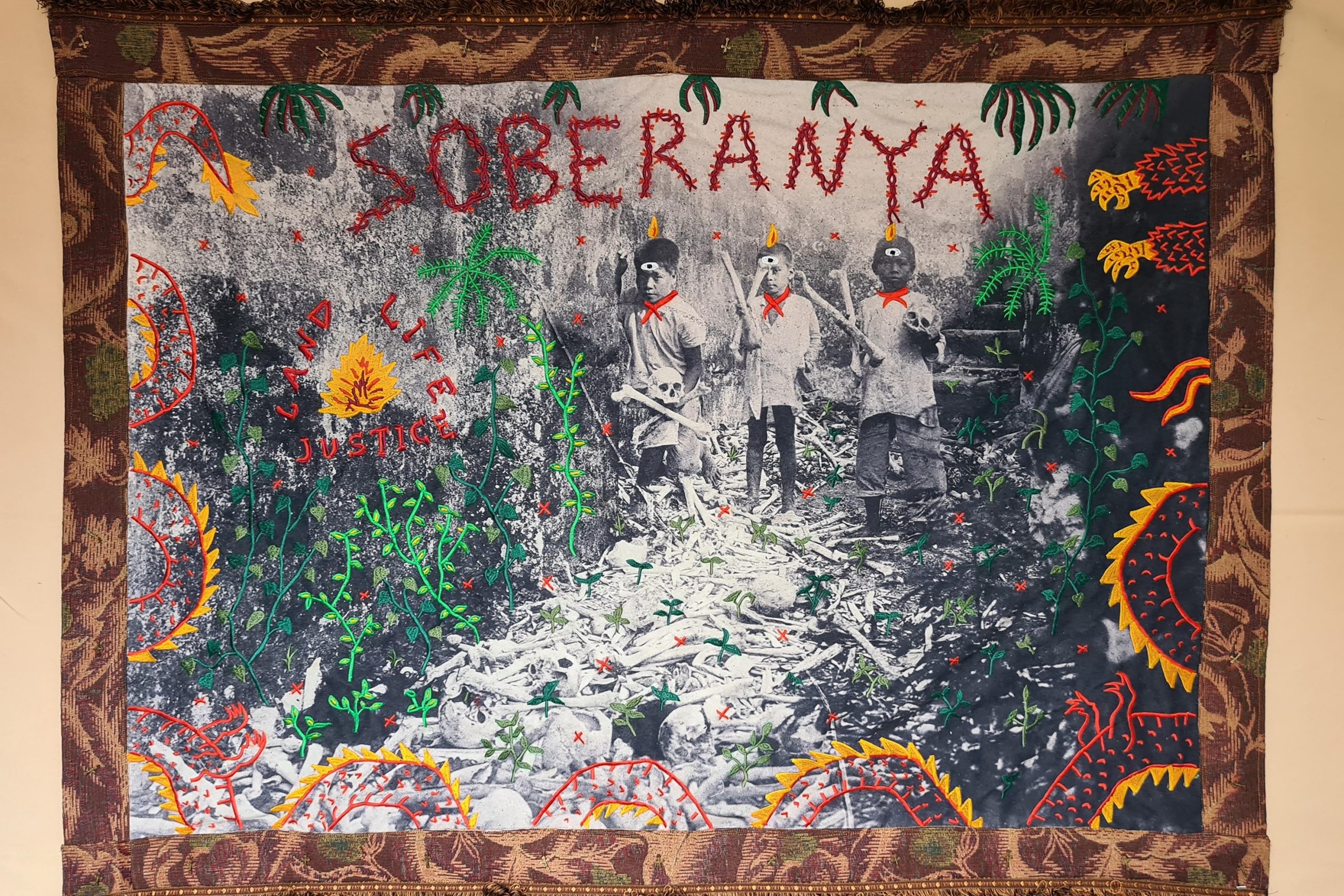
Cian Dayrit was nominated by Erin Gleeson for the work ‘Espasyo at Soberanya’ (2022). “The piece is a subversion of one of the most overlooked yet sinister tools of conquest: the colonial gaze,” says Cian. “My practice aims to find ways to redistribute power to the masses.” Elaborating further, Cian says, “My work is an affirmation of solidarity to all disenfranchised populations as I aim to appropriately echo their collective aspirations.”

The Filipino artist, who exhibits with Mono8 Gallery, a participating gallery at S.E.A. Focus 2023, notes that The Sovereign Art Foundation and similar entities are important to the art ecosystem. “I refuse to believe that contemporary art platforms are echo chambers and therefore it means a lot to be shortlisted and have the opportunity to share my work to a larger audience,” says Cian. “I encourage all cultural workers to anchor their practices to forging deeper alliances with grassroots organisations that push for progressive ideals.”

Faris Nakamura
Faris Nakamura, who is represented by Richard Koh Fine Art, another exhibiting gallery at S.E.A. Focus 2023, was nominated by Milenko Prvački. Faris says about his work, “Midnight Hour is a culmination of my inquiry of spaces in Singapore.” He adds, “Investigative, poignant with a poetic scrutiny, this work embodies the questions that I have had about privilege associated with the limited space in Singapore and its inevitable aftermath on the country’s architecture.”
The artist is known for creating minimalist works that are to be appraised from different angles for unexpected discoveries. “This work employs the distinctive trait of my practice, which is drawing the viewer in by coaxing alternate perspectives on viewing, conjuring different ways of looking at the obscured spaces in my work through squatting down, tiptoeing or shifting one’s regular movement and habits of viewing,” says the artist. “There is the constant motif of stairwells and suggestions of panels that maintain elusiveness, yet it is the focal point, calling on different layers in history such as the personal, the wider socio-economic environment and a certain political climate that anchors my continuing practice.”


The premise of the Sovereign Asian Art Prize to benefit disadvantaged children strikes a chord with Faris, who shares that he came from a single-parent family. He says, “It would be a full circle moment for me, being able to provide enriching experiences to the children and financial means of support for health and education that would improve the quality of their lives.”

Justin Lim
Justin Lim, who is also represented by Richard Koh Fine Art, was nominated by Tanya Amador. ‘Tell me about your daydream’ (2022) features a red plastic stool that is ubiquitous in Southeast Asian countries, and represents the artist’s experiences in the pandemic. “I spent many hours a day sitting and painting on one of these red plastic chairs,” says Lim. “Such an object to me can be seen as an invitation for someone to occupy an otherwise empty space or act as a reminder of a memory of someone dear who is now gone.”
The artist further ruminates on the built environment that we inhabit. “The chair itself can also be a signifier of class, identity, and hierarchies,” adds Lim. “All of these ideas seem apt to me during the pandemic, as this common everyday object accompanied me throughout this isolating period, and somewhat presented itself as a subject for my painting.”

The foundation’s goal to do good for the next generation resonates with the artist as well. Lim says, “I can’t think of a better cause if my painting can play a role in changing someone’s life for the better, and I am grateful for the opportunity.”
All 30 works can be seen online, and will also be shown at H Queen’s in Hong Kong from 10 to 18 May 2023. The public can visit for free, and vote for their favourite by 15 May. A USD1,000 Public Vote Prize will be awarded to the artist with the most popular work. Tiffany Pinkstone, Co-Founder and Director of the Sovereign Art Foundation expresses her hope that the audience will also bid on the finalists’ works, which can go towards starting or building an investment-quality art collection while supporting a worthwhile cause.
Please click here for more information about the Sovereign Art Foundation and the Sovereign Asian Art Prize, and to place a vote for your favourite artwork. The 2023 Sovereign Asian Art Prize Gala Dinner and Charity Auction will be held on 19 May 2023 in Hong Kong.